

THE AGING HARVEST
Who Will Grow Our Food in the Future?

As farmers age, young people leave the land, machines replace communal labour, and climate unsettles the old agricultural calendar, the future of food depends on whether farming can once again become viable, respected, and worth inheriting.

Outside Herat, in western Afghanistan, dust hung in the air long after the trucks had stopped moving. Families arrived with what remained of rural lives tied down with rope: bedding, cooking pots, sacks of grain, tools, children’s clothes, a few animals if they had managed to keep them alive. The old people sat quietly. The children watched everything. The men stood beside loaded vehicles as if still deciding whether the journey had really ended.
They had not left farming because they had lost interest in the land. They had left because the rains had failed, the crops had failed, and the rural economy around them had collapsed.
There I met Mohammed Hossain, one of many men whose life had been shaped by land, weather, labour, and uncertainty. More than 250,000 people were forced from their homes during that drought. They moved not as migrants chasing opportunity, but as farmers, herders, mothers, children, and elders driven from landscapes that could no longer hold them.
The camps on the edge of the city were not only places of emergency shelter. They were places where agricultural memory had been torn from the soil.
Mohammed spoke less like a man describing a weather event than a man describing a broken relationship. Rain had once come with a rhythm. Seed had once gone into the ground with a measure of trust. Animals moved according to inherited knowledge. Families knew when to plant, when to wait, when to sell, and when to hold back seed for another year.
Then the old signs began to fail.
I had seen drought before. In Australia, as a child, I remember the hard light of dry years, the dust lifting from paddocks, the silence of land waiting for rain. Later, in East Africa, I sat with farmers who spoke of the wet season as a kind of promise. For several years, the promise did not arrive. The seed went into the ground. The clouds gathered. Then nothing.
Across continents, one truth is hard to ignore: the future of food is not only a question of yields, markets, technology, or calories. It is also a question of who remains close enough to the land to grow what the world eats.
And increasingly, the people who do that work are growing old.
The Crisis Is Not Only Age
The ageing farmer has become a familiar statistic. In Europe, North America, Australia, and parts of Asia, the average farmer is nearing or passing late middle age. In many rural communities, the people still tending the land are parents and grandparents whose children have moved toward cities, universities, offices, factories, aid agencies, construction sites, or migration routes.
But the real crisis is not simply that farmers are ageing.
The crisis is that farming has been made economically fragile, politically insecure, climatically unpredictable, and culturally diminished.
It is easy to say that young people are leaving the land because cities are more attractive. There is truth in that. Cities offer education, cash income, electricity, mobile connectivity, transport, status, and the possibility of another life. But that explanation is too easy. It risks blaming young people for making rational decisions.
In many places, young people are not rejecting farming. Farming has failed to offer them a future.
To inherit a farm today can mean inheriting debt, exhausted soil, insecure land, falling water tables, unstable prices, rising input costs, and a social status far lower than the work deserves. It can mean producing food for cities while remaining poor at the edge of those same economies. It can mean carrying the risk while others capture the value.
So when a son leaves for a city, or a daughter studies nursing, teaching, engineering, or development work, this should not always be read as cultural decline. Often, it is an intelligent escape from a system that no longer rewards those who feed it.
The question is not why young people leave farming.
The question is why farming has become a way of life that so many young people cannot afford to choose.

Before the harvest comes the fieldwork: buffalo, mud, muscle, and memory. Rice farming has always depended on more than labour. It depends on knowing the land closely enough to read water, soil, weather, and season before the crop is even planted.
When the Rain Arrives Wrong
In Bangladesh this year, the early rains came in ways that unsettled expectations. Farmers had readied themselves for a season they thought they understood. The winter rice crop was close to harvest. The fields were heavy with grain. Then the rain began to arrive early, unevenly, and without the rhythm older farmers had learned to trust.
In the past, if farmers sensed early rain, the response was communal. Neighbours gathered. Families moved quickly. Men and women went into the fields with sickles, cutting rice by hand before the weather broke. It was hard work, but it had one great strength: it could mobilise many hands at once. The village itself became the harvest machine. Today, that system is changing.
Large rice-harvesting machines, many brought in from China or modelled on Chinese machinery, now move from field to field. Farmers and farm companies book them in advance. Each farmer waits for his turn. The machine is efficient when the weather holds, the field is firm, and the schedule works. It can cut hours that once took days of labour.
But agriculture is not a factory floor. It is a wager against the weather.
When rain arrives early, the machine becomes both a promise and a bottleneck. A farmer may know the crop needs to be cut. An elder may sense that the rain is turning. The community may see the danger. But if the machine is booked elsewhere, the field waits.
Then the rain comes.
The soil softens. The machine sinks. Tracks fill with water. A tool designed for efficiency becomes trapped in the very field it was meant to save. At that point, the old system returns in panic. Families rush back into the fields. Labourers are called. Rice is cut by hand in wet conditions, not as an organised act of community rhythm, but as emergency salvage.
This is the contradiction of agricultural technology. It can reduce labour, speed up harvests, and help farmers facing worker shortages. But it can also displace the social systems that once allowed rural communities to respond quickly to changing weather.
Sagar described it clearly: before, when rain threatened, people gathered and cut. Now, people wait for the machine.
That is not simply a technical change. It is a cultural one.
For some farmers, the damage was manageable. For others, it ended the season before it had properly begun. There was a story of one farmer who lost everything. After the crop failed, he went out into the field and died there. Such a story must be told carefully, because a death in a field is not a metaphor. It is not an illustration for a development report. It is a human life ending where labour, debt, weather, expectation, and despair meet.
For an elder farmer, rain is not just water falling from the sky. It is timing. It is the smell of soil. It is the direction of the wind. It is the behaviour of insects, the flowering of trees, the movement of birds, the sound of frogs, the memory of previous seasons, and the judgement of when to plant or harvest.
That knowledge is not superstition. It is an accumulated observation.
Didi Sangma and the Work of Continuity
In a Garo village in northern Bangladesh, Didi Sangma understands farming not as an abstract sector, but as household survival, land memory, women’s work, food knowledge, and obligation. Among the Garo, land and inheritance are often held through the female line. The youngest daughter may inherit the family house and land, and men commonly join the wife’s household after marriage.
In the morning, Didi moves through the household before the day has fully opened. There is rice to check, vegetables to sort, animals to feed, water to manage, and food to prepare. Around the house, the small economy of survival is visible in ordinary things: drying leaves, stored grain, fruit kept for later, firewood stacked out of the rain, a garden that is not decorative but practical.
This is where food knowledge lives. Not in a policy paper, but in the daily judgement of what can be eaten now, what must be saved, what can be sold, and what must be kept for the household.
She knows which plants survive a poor season, which leaves can be cooked, which rice variety tastes right, which foods belong to ceremony, and which crops can be trusted when cash is short. She knows the soil not as a resource category, but as part of the household’s continuity.

Didi Sangma carries greens gathered from the land around her Garo village in northern Bangladesh. Here, food, soil, water, and forest remain close to daily life, yet survival is never simple. The image captures one of the central contradictions of rural farming communities: people may live among abundance and still struggle for security.
This matters because global food debates often speak of “the farmer” as if the farmer is always male, always individual, always operating inside a market logic. In many places, that is simply not true.
Women produce food, process food, save seed, cook, feed, exchange, remember, and teach. Their work appears in the household, in the kitchen, in the garden, in the drying of food, in the feeding of animals, in the care of children and in the care of elders. Yet it often disappears when policy counts ownership, finance, machinery, formal markets, and titles.
Didi’s knowledge is not separate from agriculture.
It is agriculture.
If the future of farming does not recognise women as landholders, decision-makers, scientists, entrepreneurs, and custodians of food knowledge, it will reproduce the old system with younger faces.
This is one of the stronger points in the recent FAO discussion on Africa’s agrifood future. Charles Spillane argues that youth, women, science, education, innovation, and investment must sit at the centre of food systems transformation. He also warns against celebrating young people while leaving them to solve structural failures alone. Africa’s youth, he notes, are already working, but too often in informal systems that do not reward them properly.
That point travels far beyond Africa. Young people do not need speeches telling them farming is noble. They need land, finance, dignity, infrastructure, education, fair prices, and a future that does not punish them for staying close to the soil.
The Land Is Ageing Too
The farmer is ageing, but so is the land.
Soils are thinner. Water tables are falling. Rivers are dammed, diverted, polluted, or reduced to seasonal uncertainty. Pastures are fenced. Forest edges are cleared. Chemical use rises where soil biology has already weakened. Fields are pushed to produce more while being given less time to recover.
The old agricultural calendar, once held in the minds of elders, is becoming less reliable.
This is the quiet disaster beneath the food debate. We speak of food production as if land is a machine. Add seed, water, fertiliser, labour, and technology, and output should follow. But land is not a machine. Soil is alive. Water has politics. Seeds have histories. Crops belong to seasons. Animals require movement. Farming is a relationship before it is an industry.
When that relationship breaks, productivity may continue for a time. Inputs can hide decline. Chemicals can force crops from weakening soil. Irrigation can postpone collapse. Markets can import food from elsewhere. But the deeper account is still accumulating. Eventually, the land sends the bill.
Ali and the Closed Pastures
In Afghanistan, I worked closely with Ali from Kenya, whose family came from generations of pastoralists. Their life had been organised around movement: animals, pasture, rain, dry-season routes, kinship obligations, and the ability to read land across distance. Although Ali was working in the humanitarian world by the time I knew him, his family history carried the memory of a pastoral life increasingly squeezed by fences, conservation areas, borders, private land, roads, towns, and changing economies.
Pastoralism is often misunderstood by outsiders. It is treated as backward, inefficient, or environmentally damaging. But in drylands, mobility is intelligence. It allows people and animals to respond to rainfall, avoid exhausted pasture, survive drought, and use landscapes that cannot easily support settled farming.
Then come fences. Then come conservation areas. Then come borders, private land, farms, roads, towns, conflict zones, and mineral concessions. Movement narrows. Corridors close. Grazing becomes illegal or impossible. The pastoralist is told to modernise, settle, reduce herd size, or leave.
Ali was fortunate. He recognised the change while he was young. He received an education and moved into humanitarian work. He found another path before the old one fully closed. Many did not.
His story reveals something essential. The crisis facing agriculture is not only inside fields. It is also in the competing claims placed upon land: farming, conservation, mining, settlement, roads, tourism, carbon projects, wildlife corridors, plantations, military zones, and national borders.
These spaces should be understood together. In much of Africa and Asia, people, livestock, wildlife, forests, farms, rivers, and seasonal movement were historically intertwined. Western administrative systems often separated them: people here, wildlife there; farming here, conservation there; ownership marked by boundaries; movement treated as disorder.
The result is visible across continents. Pastoralists lose access to dry-season grazing. Farmers lose land to development. Forest communities are excluded in the name of protection. Indigenous and tribal groups are told they are threats to landscapes they helped sustain. Mining for the green economy enters rural land under the language of global necessity, while local people carry the cost.
Food systems cannot be separated from this politics of land. A field is never just a field.

At day’s end, the rice field glows with the work of people, water, and earth. Rice is one of the foundations of human life, feeding billions while binding communities to land, labour, season, and the fragile promise of the harvest.
Technology Must Serve Judgement
Technology will be part of the future of food. It would be foolish to pretend otherwise.
Precision irrigation can reduce water waste. Drones can identify crop stress. AI can help forecast disease. Mobile phones can give farmers access to weather information and market prices. Solar pumps, cold storage, improved seeds, mechanisation, and digital finance can all help when they are designed around real farming lives.
But technology carries one hard question: technology for whom?
Picture a drone moving over a vast monoculture field, reading the crop from above. It sees colour variation, moisture stress, plant density, and perhaps disease risk. It is impressive. It is useful.
Now picture an elder standing at the edge of a smaller field, reading clouds, insects, soil smell, wind direction, bird movement, and the timing of rain against decades of memory.
The mistake is to treat one as modern and the other as obsolete.
A sensor can measure moisture. It cannot be known who borrowed money for the seed. A satellite can identify vegetation stress. It cannot know which family has no grain left. AI can process weather data. It cannot replace the local memory of where water sits after a strange rain, which seeds survived the last drought, or when animals refuse to move because they sense something changing.
The future should not be framed as technology versus tradition. That is a false argument.
The future depends on balance. The best food systems will use technology to strengthen farmers' judgment, not silence it. They will combine data with memory, science with fieldcraft, and innovation with humility.
The worst food systems will use technology to remove people from land, concentrate ownership, control seed and data, and call the result efficiency.
Who Captures the Value?
Beneath all of this sits one hard question: who profits?
Farmers often carry the greatest risk while capturing the least value. They face drought, pests, crop failure, debt, rising costs, poor roads, weak storage, and volatile prices. Yet much of the profit is captured elsewhere: by traders, processors, retailers, landowners, input suppliers, commodity firms, logistics companies, financial actors, and global brands.
This is why asking young people to return to farming can sound hollow. Return to what? A life of risk without security? Labour without margin? Production without bargaining power? Knowledge without respect?
A mango rotting on the ground is not only a wasted fruit. It is a failed system of storage, processing, branding, transport, and market access. A farmer selling milk below cost is not inefficient. He is trapped in a chain where someone else controls the terms. A young woman growing food without land rights is not a potential unemployed person. She is already part of the food system, but without the recognition or authority she deserves.
Food sovereignty begins when the people who produce food regain some control over the conditions under which food is produced, valued, and consumed.
Every ageing farmer carries more than labour.
They carry seed memories, weather memories, animal knowledge, soil judgement, stories of famine and abundance, rituals of planting and harvest, ways of storing grain, preserving fruit, reading clouds, managing pasture, sharing water, and surviving bad years.
This knowledge is not always written down. It is held in hands, habits, songs, tools, recipes, field boundaries, grazing routes, irrigation channels, and family obligations. It is passed through work, not lectures. A child learns by walking behind an elder, by watching when to cut, when to wait, when to sell, when to keep seed, when to trust the sky, and when not to.
When young people leave farming, they may gain an opportunity. That should not be romanticised away. Rural life can be harsh, unequal, and limiting. Many young people leave because they should leave, at least for a time. Education matters. Choice matters. Mobility matters.
But when departure becomes one-way, something is lost. Not only labour. Continuity.
A food system can import fertiliser, machines, data, and seed. It cannot easily import belonging. It cannot quickly rebuild the trust networks that allow farmers to share water, lend animals, exchange labour, protect seed, or survive a bad season.
Once those systems break, they are not easily restored.
This is why the ageing farmer crisis is also a cultural heritage crisis.
Food is not produced by land alone. It is produced by relationships between land and people. When those relationships are severed, the loss cannot be measured only in tonnes.

In a Garo household in northern Bangladesh, plants move through a complete cycle: food for people, fodder for animals, and what remains is returned to the soil. This is not waste management. It is inherited intelligence. In Garo matrilineal society, women hold a close relationship with land through ancestry, labour, food, and household continuity. But these worlds are increasingly under pressure from industrial farming, land consolidation, and markets that rarely recognise the value of small-scale knowledge until it begins to disappear.
What Must Change
The world does not face a shortage of people capable of farming. It faces a shortage of societies willing to make farming viable, respected, and worth inheriting.
That will not be solved by nostalgia. Nor will it be solved by technology alone. It will require a different settlement between people, land, food, and power.
Young people must be able to enter farming without inheriting only risk. Women must be recognised not as helpers in the food system, but as landholders, decision-makers, producers, knowledge keepers, and leaders. Rural schools must teach science without teaching children to despise rural life. Agricultural research must leave the conference room often enough to stand in the field, listen to farmers, and learn from those who already read soil, water, seed, and animal behaviour with precision.
Soil restoration must move from the margins of environmental concern to the centre of food policy. Water must be governed as the foundation of life, not merely as an input for production. Pastoral movement must be recognised as a form of ecological intelligence, not treated as disorder. Conservation must stop excluding the very people whose knowledge shaped many of the landscapes now being protected.
The same test should be applied to mining, infrastructure, carbon projects, and green-energy transitions. They cannot be judged only by distant targets or global necessity. They must also be judged by what they do to rural land, food systems, local rights, and the people who live with the consequences.
Technology must face the same test. A machine that helps a farmer harvest before rain can be a blessing. A machine that makes the farmer wait while the rain comes can become another form of risk.
The farmer of the future may not look like the farmer of the past. She may use a mobile phone to check market prices, a solar pump to irrigate vegetables, a cooperative to process fruit, and traditional seed knowledge inherited from her grandmother. He may move between the farm, the town, and the digital marketplace. They may be part farmer, part processor, part researcher, part entrepreneur, part custodian of land.
That should not frighten us.
Cultures survive by adapting. Farming has always changed.
But the change now must not be dictated only by corporations, urban consumers, distant investors, or policy rooms far from the field. It must begin with those who still know what it means to wait for rain.
The Last Field
The phrase “food security” has become so familiar that it risks losing its force. It sounds technical, managerial, and solvable through targets, dashboards, and investment plans. But food is older than policy. It is seed, soil, water, labour, hunger, memory, family, ritual, trade, and trust.
A society that does not respect farmers should not be surprised when its young people do not want to become them.
A society that exhausts the soil should not be surprised when the harvest weakens. A society that blocks pastoral movement should not be surprised when dryland food systems fail. A society that treats rural life as backward should not be surprised when rural knowledge disappears. And a society that believes machines alone can replace community should not be surprised when efficiency fails in the mud.
The ageing harvest is not only a warning about demographics. It is a warning about value. We have asked farmers, herders, fishers, seed keepers, and rural women to feed the world while too often denying them dignity, security, fair reward, and a future their children would choose.
So the question remains.
Who will grow our food?
The answer will not be found only in laboratories, investment forums, climate models, or agricultural conferences, though all have their place. It will be found in whether we can rebuild the broken covenant between people and land.
Because the future of food does not begin in the supermarket, the commodity exchange, or the policy document.
It begins where Mohammed Hossain once waited for rain.
It begins where Didi Sangma reads the soil beside her home.
It begins where Ali’s family once moved animals across open land before the fences came.
It begins in a field, with someone still willing to plant.
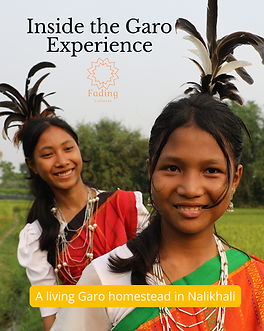
Don’t just read about living culture. Step into it. Discover The Garo Experience in Nalikhali.
