
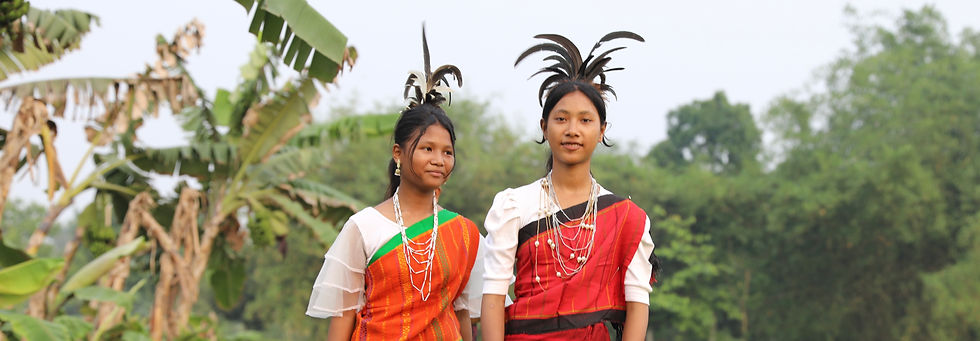
A Visual Field Essay from the Garo Record Villages of Northern Bangladesh
Women, Land, and the Children Who May Yet Return
A Culture Divided by a Line
Photo Story by Dr Tom Corcoran
Didi’s wealth is standing in the yard.
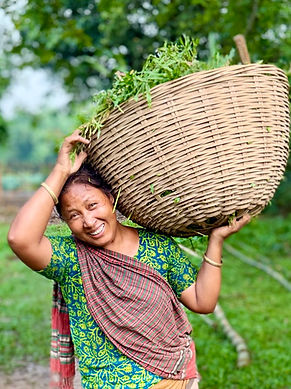
It has four legs, eats cut grass, and may one day pay for a doctor. In Nalikhali, a Garo village near Bangladesh’s northern border, savings do not always sit in a bank. They breathe. They chew. They wait. Didi cuts feed for the family’s animals with the speed of someone who has done this thousands of times. Two cows. Two pigs. A household economy measured not in surplus, but in readiness.
One pig may be sold or consumed when times are good. The cows are different. A cow can become a hospital bill overnight. It can pay a debt, cover a school cost, or carry a family through a crisis when formal security is too distant to matter. From this small act, the wider story begins.
This is the Garo world in northern Bangladesh: matrilineal, Indigenous, rural, Christian in many villages, rooted in land and women’s inheritance, yet increasingly exposed to land loss, migration, state neglect, and the slow thinning of language and memory.
The Garo were not divided by culture. They were divided by a line. And that line changed the value of their land, their language, and their future.

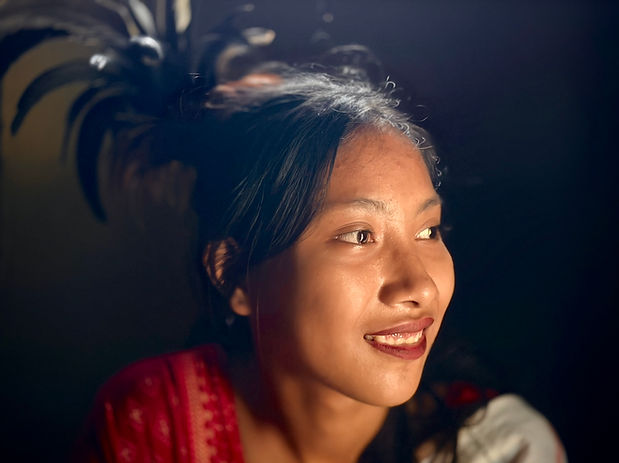
Prakriti makes a traditional feather Do' mi
She sits quietly, binding feathers for a traditional Garo dress.
Her fingers move with the concentration of someone making something she already knows belongs to her. The feathers will be worn in dance, ceremony, and celebration. They are light in the hand, but heavy with meaning.
She has made these since childhood. Dance has been part of her cultural life for as long as she can remember.
The headwear, known locally in Garo festive traditions and sometimes described as Do’mi for feather adornment, should be confirmed with elders before final publication. But the meaning is already clear.
This is not a costume.
It is memory made visible. Prakriti is fourteen. She studies in Bangla, speaks Garo at home, learns English, gathers food, helps Didi, dances, and moves between worlds that do not equally value her identity.
She is not choosing between the old world and the new. She is being asked to carry both.


For Garo girls, tradition is not behind them.
It is the future they are being asked to carry.
Prakriti’s future
The Bonds of the Women
The women sit close, sharing stories, myths and gossip, a conversation that can flow without end.
This is how social life holds. Not through official meetings, but through repeated presence. Sitting together. Working together. Watching children. Sharing news. Preparing food. Remembering who belongs to whom, which daughter will inherit, which family is under pressure, which land has been leased, and which child may leave for study or work.
The Garo are matrilineal. Traditionally, descent and inheritance pass through the female line, and the youngest daughter often carries particular responsibility for the family house. But matriliny is not a shield against poverty. It is not automatic power. It does not protect land on its own.
In Bangladesh, where the Garo people have limited legal recognition as Indigenous people, women may inherit responsibility without inheriting security. A daughter may receive the house. But what is a house without land strong enough to sustain it?


Francila teaches the loom
At the loom, Francila Nokrek shows Prakriti and Pernita how rhythm comes before pattern. The shuttle moves. The threads tighten. The cloth appears slowly, line by line. This is not fast work. It asks the body to learn sequence, tension, timing, and patience. The lesson is in the hands as much as in the mind.
Garo dress, including forms known as Dakmanda and Doksari, is not simply fabric. It is a public identity. It marks belonging. It carries colour, memory, status, and the quiet declaration of a people still present on their own land.
In Nalikhali, this knowledge now survives locally through only a small number of hands. Francila is one of those hands. That matters. When weaving narrows to a single family, a whole visual language is put at risk. If the loom falls silent, the loss is not only cloth. It is pattern, posture, memory, and the discipline of making. Prakriti and Pernita are not only learning how to weave. They are learning how a people remain visible.


Life in the Doorway
A mother sits with her child at the threshold. In Garo village life, the doorway is not a private edge. It is one of the community's great social spaces. People sit at doorways to talk with family, watch children, greet neighbours, and follow the movement of village life as it passes along the lane.
This is where information travels. Who is ill? Who has harvested? Who needs help? Who has food to share? Who has borrowed tools? Who is leaving for work? Which child is doing well at school? Which family is under pressure?
In this way, the doorway belongs to the solidarity economy. Knowledge, labour, food, care, news, and small goods move between homes through everyday contact. Nothing is formal, but much is understood. A bowl of rice, a handful of greens, a warning, a story, a favour, a loan of time. These exchanges hold the village together. Inside is the household. Outside is the wider world. Between them sits the mother, holding the child, the house, and the future in a single frame.
In Garo society, the mother line matters. It carries inheritance, belonging, obligation, and memory. But the pressure on that line is growing. Land is fragmented. Some is leased. Men migrate for work. Children are educated in other languages. Markets pull young people outward. Roads bring the majority culture closer. The child in the doorway inherits more than a home.
He inherits a network of obligation, care, memory, and exchange. And he inherits a question: what will still be here when he is old enough to understand what was given to him?


Backroads Where Time Slows
The back roads of northern Bangladesh wind slowly through green countryside.
Carts, rickshaws, bicycles, and small vehicles pass between homes, fields, schools, churches, ponds, and markets. People travel with purpose. A child going to school. A woman carrying food. A farmer heading to the field. A visitor moving through a landscape where every bend in the road belongs to someone’s memory.
This is a beautiful country to move through. But beauty should not soften the truth.
These villages are not timeless. They are changing quickly. Land is under pressure. Young people are looking outward. Language is thinning. Traditional knowledge is becoming optional. A culture that once lived through necessity now has to be chosen. That is a dangerous threshold. When a culture must be chosen every day in order to survive, it has already entered a more fragile age.



Learning to Return
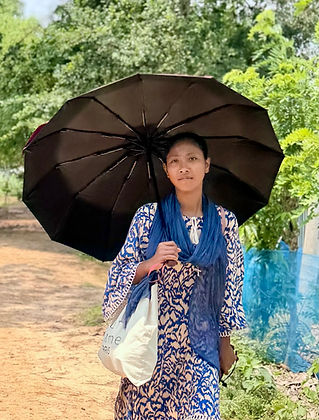
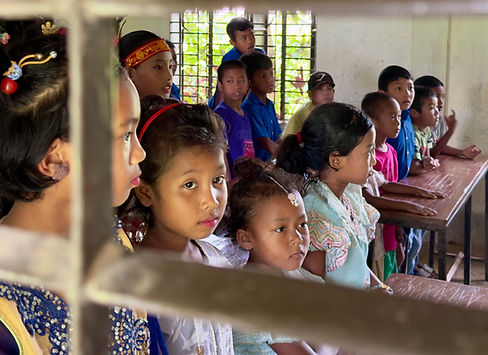
For Garo children, school has long been seen as the way out. That is understandable. Education offers Bangla, English, exams, jobs, confidence, mobility, and escape from rural poverty. Parents want their children to have choices they never had.
But a harder question is now emerging. What happens when education teaches children how to leave, but not how to return? What happens when a child learns the language of the state, but loses the language of the grandmother? What happens when success is measured only by distance from home? The answer cannot be to reject education. That would be foolish. The answer is to build an education strong enough to carry both worlds.
Children should learn Bangla.
They should learn English.
They should pass exams.
They should enter universities.
They should travel.
But they should also know the Garo names of plants, rivers, fields, songs, dances, kinship lines, foods, weaving patterns, and family places. They should be able to move through the world without leaving home behind.


What Remains at the Doorway
By the time the road leaves Nalikhali, the story has already changed shape. It began with Didi cutting grass for animals, with wealth standing in the yard and security breathing beside the house. It moved through feathers, women’s conversations, Francila’s loom, bamboo split by hand, greens gathered before school, and children learning languages that may one day carry them far from home.
Nothing here is symbolic to those who live it.
The cow is money when illness comes.
The doorway is where news travels.
The loom is a public language.
The mother line is inheritance, but also obligation.
The road is freedom, but also departure.
The school is promise, but also risk.
This is what makes Garo life in Bangladesh so powerful to witness. It is not disappearing in the dramatic way outsiders often imagine cultures disappear. It is being thinned at the edges, pressured in the centre, and asked to survive without the full protection of law, land, or recognition.
Across the border, many Garo communities in India live within a stronger framework of tribal recognition and political space. In Bangladesh, the same people remain more exposed. The line did not divide their songs, their food, their kinship, or their memory. It divided the conditions under which those things could continue.
That is the wound.
But the answer is not nostalgia. The answer is not to freeze Garo culture into performance, costume, or festival. The answer is to keep it lived: in houses, fields, classrooms, kitchens, churches, looms, backroads, language, and land.
For children like Prakriti, the future should not be a choice between leaving and belonging. She should be able to study Bangla and English without losing Garo. She should be able to travel without shame. She should be able to return without feeling that return means failure. She should inherit not only memory, but dignity, land, language, and choice. That is what is at stake here. Not the survival of an old way of life as a relic. The survival of a living people as themselves. The Garo were not divided by culture. They were divided by a line. Now the work is to make sure their children can cross the future without losing the mother line behind them.
Learn More About the Garo Way of Life through the Garo Experience


