
ETHNOMAD
APRIL 2026

Dispatch From the Field
April Cover Story

North of Dhaka, a different order still holds. Among the Garo, or A·chik Mande, land passes through women, memory moves through the household, and culture is lived rather than displayed. This opening chapter begins not in the forest, but in the city, with a security guard whose return home reveals a system far older and more complex than the labels used to describe it.
This is the entry point into a world under quiet pressure, where songs fade, language thins, and continuity is no longer guaranteed. ETHNOMAD steps inside, not to observe from a distance, but to document and support what remains while it is still being lived.
CHANGING NATURE:NEWS UPDATES

Opening ~August 2026
Set in the Garo village of Nalikhali in northern Bangladesh, the Garo Experience Guesthouse is a homestead stay being developed through ETHNOMAD’s Field Dispatch as part of a wider effort to support cultural continuity, local livelihoods, and careful, place-based travel. More than accommodation, it is intended as a living encounter with land, food, music, craft, and the daily rhythms of Garo life, shaped by matrilineal tradition and village hospitality. The guesthouse will offer a small number of thoughtfully prepared rooms alongside opportunities to experience weaving, cooking, rice wine, storytelling, farming life, and the wider landscape, creating a stay that is grounded, personal, and deeply connected to the people who call Nalikhali home.

In early 2026, thousands of Indigenous defenders gathered along Brazil’s Tapajós River to oppose a government decree that would have opened the waterway to industrial concession and dredging. After more than a month of sustained resistance, the decree was revoked. In a year marked by ecological strain, the river did not change course. The government did.
STORIES & RELECTIONS

The Wave That Changes Bali:
Surf culture and the transformation of an island
The Wave That Changed Bali looks at how surf culture helped reshape the island’s modern identity. What began with a handful of outsiders chasing waves along Bali’s coast gradually opened the door to a far larger transformation in tourism, land use, architecture, and local life. This article traces how a surf frontier became part of a global image, and asks what was gained, what was lost, and how Bali changed in the process.
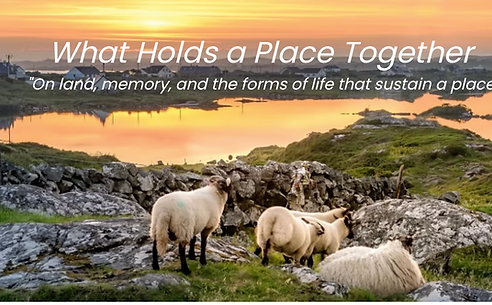
What Holds A Place Together
On land, memory, and the forms of life that sustain a place
What Holds a Place Together follows the quiet architecture of rural life: the farmer people seek out, the gate left half open, the market where news travels, the old farm that still gathers a scattered family home. Moving between Ireland and France, the story asks what sustainability leaves unmeasured: memory, trust, obligation, and the human bonds that keep a place alive long after the numbers have been counted.
Voices from the Field
The Garo Record begins with voices that do not merely describe change, but carry its texture. In one song, an old man recalls an earlier social world with wit and bite. In another, an elderly woman speaks of the Re Re songs and of how they have fallen away, no longer held in memory as they once were. A community leader speaks more plainly still: the Garo language is receding, Bangla is taking its place, and many young people are no longer learning the speech of their elders. Taken together, these are not loose fragments of folklore. They are evidence of a culture under pressure, and of a people living through the quiet erosion of continuity.
What makes these testimonies so powerful is their ordinaryness. Cultural loss rarely arrives as a single rupture. More often, it comes through substitution, hesitation, and silence. A song no longer sung at the right time. A phrase no longer spoken in the home. A child who understands but does not reply in Garo. This is how a language thins, how memory loosens, and how a way of life can remain visible on the surface while deeper structures begin to weaken underneath. The Garo Record exists to pay close attention to that threshold, where culture is still alive, but no longer secure.
At its heart, The Garo Record is an act of witness. It is an effort to listen carefully to what remains in voice, song, story, craft, land, and kinship before these, too, are reduced to recollection. It does not treat Garo culture as a museum piece or a sentimental remnant. It treats it as a living system of knowledge and belonging, one now under pressure from dominant language, modern aspirations, migration, religion, and the heavy pull of the majority world around it. What is at stake is not simply heritage in the narrow sense, but an entire way of carrying memory forward. Culture survives only when it is practised, spoken, sung, and passed on. That is the ground on which The Garo Record stands.
Join ETHNOMAD’s River Transect: Climate and Change, a journey tracing the Teesta River from the Himalayas to the Bay of Bengal. Discover how tribal, Indigenous, and river-based communities live, adapt, and sustain their traditions amid shifting waters and a changing climate. Explore stories of resilience, heritage, and hope at ethnomad.com and fadingcultures.org.
We have launched a new core section on the ETHNOMAD website: Field Notes & Foundations. This space brings together our deeper research and methodological work, including ethnographic guides, Yarning frameworks, conference papers such as From Cave to Canvas, and long-form field research across heritage, ecology, and community-led conservation. It is a living archive of how we work in the field and how knowledge is built over time, grounded in lived experience rather than abstraction.


Most Widely Read Article of March

What The Fire Carries
Living Heritage and the Architecture of Survival
In the forests of New South Wales, beneath campfire smoke at Myall Lakes, and across landscapes marked by dispossession and return, this article considers how a people remain connected to land through story, song, art, and ceremony. It argues that Aboriginal heritage is not a relic preserved for display, but a living architecture of continuity, carrying law, memory, ecology, and obligation across generations. Woven through with reflections on exile, transmission, and survival, the piece is ultimately about what keeps both people and place intact.