

The Gurjar Girls
Girls, Buffalo, and the Knowledge of
Coexistence in Sariska Tiger Reserve
ETHNOMAD

Article by Dr Tom Corcoran
Published by ETHNOMAD

We were running late, and we both knew it. Heading toward the Tiger Reserve at dusk is never advisable. As the light falls, the forest changes hands. What moves then is rarely seen until it is close.
We were riding up toward Kraska village as the light began to thin, the old Royal Enfield labouring steadily over the rough track that cuts into the forest. I was travelling with Sasha, a close friend who knows Sariska as well as anyone from the outside can. The forest had gone quiet in that particular way it does as the light dims, when birds begin their last calls, the first bat takes flight, and the air itself seems to listen.
At the edge of the reserve, Sasha slowed and pulled to a stop. He checked his phone and found a dozen missed calls. He rang back immediately.
“Stay where you are,” Surjan said. “There’s a tiger on the back trail. If you keep going, you will probably drive straight into it.”
So we waited. Engines off. No panic. No dramatics. Just a simple decision, made with local sense and a proper respect for the place. We would sit it out at the forest edge and see if the track cleared by morning.
This is what living with tigers actually looks like. Not the controlled encounter of a safari jeep or the rehearsed stillness of a lodge balcony, but judgement exercised in fading light, guided by trust and local knowledge. The tiger was not a symbol. It was an animal moving through shared ground.
I have walked and ridden in and out of the Sariska Tiger Reserve many times. Each time, I place my trust not in signs, gate records, or patrol schedules, but in the people who live here. The villagers know where the tigers are and, more importantly, how to move accordingly. They speak even less openly about the leopards, though everyone knows they are there. Tigers command attention from outsiders. Leopards are another matter. They are closer, quieter, and more difficult to read.
Among the people who live within this world are the Gurjar, pastoralists whose lives are shaped by movement, livestock, and an intimate reading of the forest. They do not speak of wilderness in the abstract. They speak of trails, water, grazing, shade, danger, timing, and weather. Their knowledge is practical, embodied, and learned early. That knowledge is nowhere more striking than among the girls.

Ajun rests beside her buffalo in Kraska village, deep inside the Sariska Tiger Reserve. Among the Gurjar, buffalo are not simply livestock. They are family wealth, daily labour, food security, and living companions, known through years of care. In this quiet closeness lies a relationship outsiders often fail to understand: coexistence is not an idea here, but a life learned by touch, trust, and responsibility.
Each morning, as the light begins to strengthen, they head out along narrow paths worn by generations of feet. Some go to gather fodder. Some climb for leaves. Some help tend buffalo and watch younger children. Their movements are unhurried, but never careless. They move through a landscape where tigers, leopards, hyenas, wild boar, and crocodiles also move. Fear does not govern them. Attention does.
One of the strongest images from the village is of Ajun seated beside her buffalo, her hand resting on the animal with the ease one normally sees between family members. That ease is not sentimental. It is earned. For the Gurjar, buffalo are not simply economic assets. They are central to household life, daily rhythm, nourishment, and identity. The bond between the girl and the buffalo is built through work, dependence, familiarity, and long habit. These animals are fed, led, protected, watched over, and known individually. In return, they sustain the family.
To outsiders, this may look like affection. In truth, it is something deeper. It is kinship through labour and care. That relationship tells us something essential about Gurjar’s life. Their world is not organised around a sharp division between human and animal. Dogs, buffalo, children, elders, and the forest itself all sit within one lived field of relationship. The domestic and the wild are not neatly separated. They overlap, and within that overlap, the Gurjar have built a way of life.
Another girl, Prim, dressed in blue, revealed a different side of that same relationship with the land. When I followed her toward the forest edge, what struck me was not merely her confidence, but her physical intelligence. She climbed quickly and lightly, moving from trunk to branch with the ease that only comes from repetition. Yet there was nothing reckless in it. Her movements were measured, precise, and economical. She was not conquering the tree. She was moving within a world she already understood.
Outsiders often mistake such scenes for picturesque survivals, as though these girls are remnants of some older India. That is too shallow. Their movement through the landscape is part of an active ecological life. Through cutting fodder, managing buffalo, guiding grazing, and knowing when and where to move, Gurjar families do not merely occupy this plateau. They help shape it.
There is a real relationship between the long-term presence of buffalo on the plateau and the reserve's broader ecology. Grazing, browsing, and the habitual movement of livestock through certain spaces influence vegetation patterns, open ground, seed movement, and the rhythm of human and animal use. This is not a simple claim of cause and effect. Forests are complex, and Sariska is no exception. But it does mean the Gurjar should not be treated as intruders in a natural system from which humans are absent. They are part of this landscape's history, and their presence has long interacted with it.
For most of human history, people did not stand apart from nature. They moved within it, constrained by its limits and attentive to its warnings. Modern life has steadily weakened that old discipline. Conservation today often tries to protect wildlife without fully understanding the human knowledge that once made coexistence possible.
Among the Gurjar, that knowledge begins in childhood.
Children here learn by moving through a world where listening matters and mistakes carry weight. They learn how silence can signal danger. They learn where animals tend to pass, what times of day matter, when to keep distance, and when to move on. These are not lessons delivered in classrooms. They are absorbed through repetition, instruction, and consequence.
It became clear just how grounded these children are in their environment one morning when we planned to take a group of older children on a field trip to Jaipur. Some had never left the park. None had experienced a city.

The Gurjar girls prepare for the afternoon in the treetops, carrying a small axe and a bamboo pole. They move deliberately, selecting trees often more than a hundred metres apart and staying in contact through soft whistles and calls. The work connects them, their buffalo, and the trees in a relationship that sustains them all.
We gathered early at the school in Kraska: a small group of children, two teachers, Sasha and me. The light was still soft, the forest holding its early-morning mood. We had a long walk ahead, descending from the plateau to the edge of the reserve where transport would meet us.
Before we set off, one of the community leaders pulled Sasha and me aside. “When you are walking out through the forest, watch the children,” he said. Sasha smiled. “Don’t worry, Pandit-ji. We will watch over them. They will be fine.” The elder looked directly at him. “I am not worried about the children. It is you two who need to watch them. Follow them. If they react to something, do exactly as they say.”
That was the truth of it. This was their environment, not ours. The children were not the vulnerable ones. We were. They carried the instincts. They knew the ground.
Later, in the traffic, noise, and polluted air of Jaipur, the inversion was complete. In the forest, the children were guides. In the city, they became novices overnight. The knowledge that kept them safe among predators, ridgelines, scrub, and ravine suddenly counted for nothing. It had no recognised value there.
That is one of the deeper tragedies facing communities like the Gurjar. Their skills are precise, adaptive, and hard-won, yet modern society struggles to see them as knowledge at all. When we returned to the village, life slipped back into its familiar rhythm. Smoke rose from cooking fires. Buffalo shifted in their enclosures. Dogs moved between households. The girls resumed their tasks with the ease of people returning to the proper scale of life. They spoke of Jaipur with curiosity, but there was no confusion about where they belonged. They were glad to be home.
That home, however, is changing. Formal education arrived late in Sariska and only through sustained community effort. The small village school, supported by Bodh Shiksha Samiti, has altered routines and widened horizons, especially for girls. Teachers are respected not only because they bring literacy and numeracy, but because they represent an ability to move between worlds. For some girls, becoming a teacher is now imaginable in a way it never was before.
But the school ends at grade five. Beyond that, education requires leaving the reserve. This is where the real tension begins. Outside observers often speak of education as an uncomplicated good. In many respects, it is. It offers confidence, language, opportunity, and access to institutions that shape the future. But in communities under pressure, education can also become preparation for exit. It can become preparation for displacement.
That may sound harsh, but it names a real dilemma. To continue schooling, Gurjar girls may have to leave the plateau, leave their buffalo, leave the rhythms of the forest, and enter a world that does not recognise the value of what they already know. If they succeed there, they may gain new forms of power. They may also be drawn away from the knowledge, habits, and obligations that tie them to home. The result is not always liberation. Sometimes it is a slow estrangement.
This is why the question of girls’ education is discussed so carefully within the community. These are not backward people resisting schooling. They are people thinking seriously about consequences. Parents weigh hope against separation. Elders consider what is gained and what may not return. Families ask not only who will pay the fees, but who will tend the buffalo, who will care for younger siblings, and what sort of person a daughter may become when trained in a world far from her own.
The concern is practical, moral, and cultural. What happens when education trains children for a life elsewhere, rather than helping them live more fully and more powerfully where they already are? What happens when schooling gives a child the tools to leave, but not the tools to remain?
For communities already facing conservation pressure, this is no small matter. If education is structured solely around absorption into the outside world, it can become another mechanism by which belonging is weakened. It may not directly force displacement, but it can prepare the ground for it. People first lose confidence in the value of their own knowledge. Then they lose their young. Then, in time, they lose the practical means of remaining on the land at all.
The Gurjar question, therefore, matters far beyond one village. It forces us to ask what education is for. Is it only a ladder out? Or can it also be a means of strengthening a people in place? Inside the reserve, these larger questions are never far from the authority's presence. Rangers patrol. Vehicles are logged. Movement is monitored. The Gurjar speak about this plainly, without melodrama. They know that conservation is not neutral. They know that wildlife recovery, tourism, and state power do not always align with the lives of those who have long inhabited these landscapes.
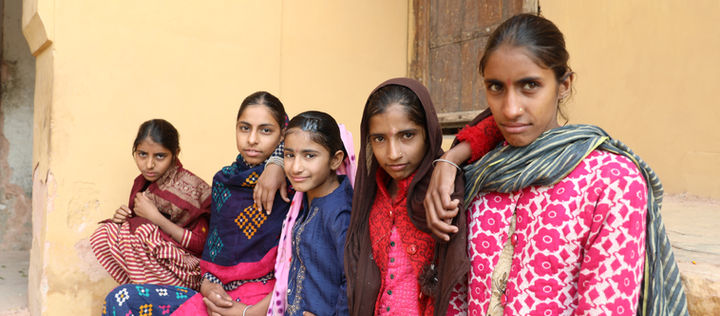
A group of Gurjar girls on a field trip beyond the Sariska Tiger Reserve, for some, their first journey outside the forest. Their expressions are serious, almost guarded, but behind them is a confidence few outsiders can imagine. These are girls who grow up among tigers, leopards, buffalo, thorn forest, and firelight, carrying a spiritual and practical understanding of nature that many modern societies have spent generations trying to recover.
Park managers are the gatekeepers of the reserve, and patrols regularly pass through the village. There is even a ranger hut now positioned within binocular view. Everyone entering or leaving in a vehicle is logged at the outside gate. The Gurjar say much of their movement is still through the back trails, through the forest, across the ridge, on foot or by motorcycle. Not to hide, they insist, but because life here requires them to move according to the land, not according to a gate register.
Rangers are tasked with managing a reserve through patrols, records, and regulations. The Gurjar experience the same forest through feet, animals, weather, loss, hunger, work, and memory. That distinction matters. In conversations beyond the reserve boundary, guides and drivers often express the logic plainly. More tigers mean more tourists. More tourists mean more revenue. Numbers become targets rather than thresholds. The forest becomes a balance sheet, its success measured upward without sufficient regard to saturation or consequence.
The Gurjar ask a more difficult question: how many tigers are enough? It is not an anti-conservation question. It is a conservation question of the most serious kind. Every landscape has limits. Every predator population requires prey, space, and movement. Every human community living within that landscape must also manage risk, labour, and survival. A drought, fire, disease outbreak, or decline in wild prey can quickly alter the balance. When that happens, livestock may become more vulnerable, and the burden falls first on those who live closest to the animals that others travel to admire.
The tiger's return to India is a real achievement. Few would deny that. But success cannot be measured only in predator numbers. A conservation model that counts tigers while ignoring the human knowledge systems that have long existed alongside them is incomplete at best and destructive at worst.
The Gurjar also notice what others prefer not to discuss. When people with deep local knowledge are removed from a landscape, absence does not automatically produce protection. Empty spaces can invite new forms of exploitation. Poaching, illegal cutting, and outside intrusion do not disappear simply because pastoralists are relocated. Those who know the forest most intimately are often those most able to notice when something is wrong.
This is not to romanticise the Gurjar. Coexistence is not harmony. It is hard work. It includes risk, loss, argument, compromise, and daily negotiation. But it is real, and it has been learned over generations.
That is why the girls matter.
They are not background figures in a conservation story about tigers. They are central to the story of Sariska itself. In their movements between buffalo, school, forest, and firelight, they carry several futures at once. They are daughters of pastoralists. They are students. They are workers. They are knowledge holders. They are children of a landscape where the wild and domestic worlds meet every day.
When Prim climbs into the trees to cut fodder, she is doing more than completing a household task. She is practising balance, judgement, and ecological memory. When Ajun rests beside her buffalo, she is not posing with an animal. She is sitting beside a being that helps sustain her family and anchor her place in the world. When girls walk through the forest at dawn, they carry forms of awareness that no school textbook currently measures.
Modern conservation has become skilled at counting animals, drawing corridors, producing maps, and managing tourists. It has been less willing to ask how people learn to live with danger, how children develop attention, how pastoral knowledge shapes land, and how cultural continuity supports ecological presence. That failure is not academic. It shapes policy. It shapes relocation. It shapes whose knowledge is heard and whose knowledge is dismissed.

Prim Gujar, high in the treetops of Sariska, cutting fodder leaves for her family’s buffalo. What might look like damage is in fact a form of careful coppicing, guided by generations of Gurjar knowledge. When practised with restraint and timing, this practice stimulates new growth, keeps trees healthy, and sustains both forests and livestock. It is not exploitation. It is management, learned by watching the forest closely, year after year.
As evening settles over Sariska, the plateau reorganises itself. Predators begin to move. The village quietens. Fires burn low. Buffalo settle near the households they sustain. Somewhere in the dark, a tiger may pass. Somewhere nearer still, a leopard may be watching. And in the village, the girls remain at the centre of it all, tending animals, gathering fodder, learning at school, listening to elders, and carrying a knowledge that conservation still scarcely knows how to value.
Their future now sits between two demands: to be educated, and to remain rooted; to prepare for the world beyond the forest, and to hold fast to the one that made them.
Whether India can protect both its tigers and the people who have long shared their landscape remains unresolved. But if that balance is ever to be found, it will not come from numbers alone. It will come from learning to see girls like these not as relics of a fading past, but as part of a living intelligence without which the forest itself is less understood.

Prim Gurjar sits by her fire in quiet reflection, much as her ancestors did. At her young age, she has known only the rhythms of the forest and the seasons, without electricity or constant interruption. She may be among the last of her tribe to experience life in this way.
