The Honey Makers
Honey, forest beekeeping, and the old agreement between people and nature.
By Dr Tom Corcoran
Published by ETHNOMAD
Long before sugar became cheap, before sweetness could be bought in packets or poured from plastic bottles, honey belonged to risk, patience, smoke, weather, and the forest.
In the Cuevas de la Araña, the Spider Caves of Valencia in eastern Spain, an ancient painted figure hangs from what appears to be a rope or vine, reaching into a wild hive while bees swarm around the body. The image, estimated to be around 8,000 years old, is often described as one of the earliest known depictions of humans gathering honey.
It is not a peaceful image.
It is a body suspended between rock and air. A human being reaching into danger for sweetness. A swarm in motion. A hand extended toward something precious, guarded, and alive.
That old painting still holds the truth of honey. It was never simply taken. It had to be earned.
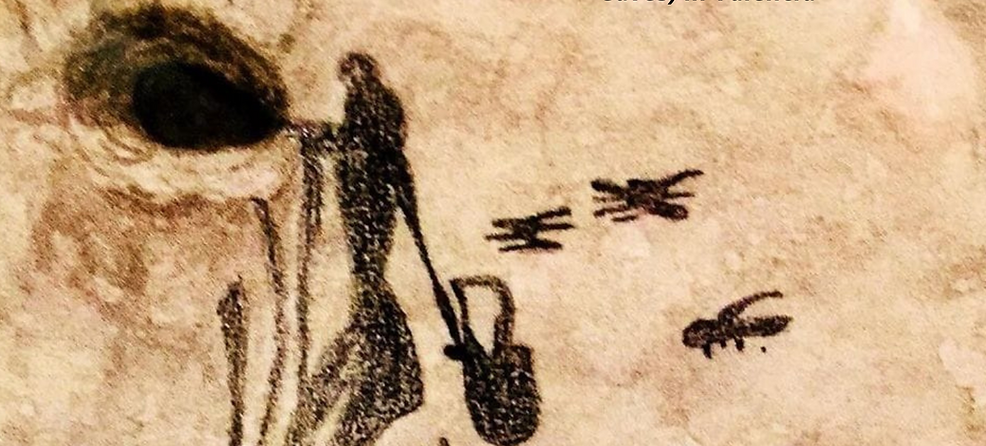
In the Spider Caves of Valencia, an ancient honey gatherer hangs between rock and swarm, reaching into a wild hive for one of humanity’s oldest forms of sweetness. The image is not simply a record of food gathering. It is an early portrait of risk, skill, and the long relationship between people, bees, and the living world.
From the mountains of Spain to the green fields of Ireland, from the rolling hills of Romania to the wide plains of Ukraine and the vast forests of Belarus, honey has carried more than flavour. It has carried household memory, rural economy, folk medicine, monastic discipline, seasonal labour, and the old knowledge of people who understood blossom, rain, smoke, bees, and restraint.
On a bicycle journey through Eastern Europe, moving slowly through villages, forests, rough roads, and market towns, I began to see honey differently. Not as a luxury. Not as a health product. Not even as food alone.
Honey was a map of a place.
At rural stalls, jars of honey sat in rows like captured light. Some were pale and floral. Others were dark, almost woody. Some held the taste of meadow flowers. Others carried buckwheat, lime tree, forest blossom, or late summer fields. A jar from one valley did not taste like a jar from another. It could not. Bees do not make abstract honey. They make the taste of where they have flown.
The further I travelled, the more I noticed how often honey appeared at the edge of rural life. On kitchen tables. At roadside markets. In village stores. In old houses where someone would open a cupboard and bring out a jar with pride, as though offering not a product, but evidence of the season.
In Belarus, the connection seemed older still. There, in forest country, people spoke of beekeeping not simply as a rural craft, but as an inheritance. The older forms of tree beekeeping had not entirely disappeared into museums or nostalgia. They survived in memory, in tools, in language, and in the hands of people who still understood the forest as a working world.
Ilyas, a local beekeeper, showed me his equipment with the plain seriousness of a man who did not need to exaggerate his knowledge. The axe. The rope. The basket. The old wooden hive. The marks on trees. The smoke was used to calm the bees. Nothing was theatrical. Nothing was staged. These were not props for visitors. They were working objects, shaped by generations of use. He spoke about bees as farmers speak about rain or shepherds speak about lambing. With respect, caution, and the quiet acceptance that nature cannot be ordered about.
“We work on the bees’ time,”
Ilyas said, laughing. Not our own. That sentence stayed with me because it runs counter to the arrogance of the modern world. So much of contemporary life is built around human demand: faster delivery, higher yield, constant supply, cheaper food, cleaner packaging, perfect availability. Bees ignore all of this. They follow flower time, weather time, queen time, and winter time.
A beekeeper may own the box, but he does not own the season. This is the moral centre of beekeeping: restraint. A bad beekeeper takes honey. A good beekeeper keeps bees alive. Tree beekeeping, particularly in Belarus and Poland, is now recognised by UNESCO as an intangible cultural heritage practice. But the word “heritage” can be misleading if we treat it as something decorative. Real heritage is not costume. It is not performance for outsiders. It is work remembered through the body. It is knowing when to climb. When to wait. When to harvest. When to leave enough behind.

For centuries, honey and wax were central to the economies of Eastern Europe. Before electric light and paraffin, beeswax lit homes, churches, and monasteries. Honey-sweetened food, preserved fruit, fed households, and moved through trade routes connecting forests, rivers, towns, and distant markets. In the lands of the old Grand Duchy of Lithuania and the Polish-Lithuanian Commonwealth, tree beekeeping became valuable enough to be governed by law. Bee trees had owners. Rights mattered. Theft mattered. Forest access mattered.
The hive was a small world, but it sat inside a much larger one: law, land, trade, belief, and survival. Then came the usual forces that push living traditions toward the margins. War. Population loss. Shifting borders. Industrial forestry. New land systems. Modern hive technologies. The reorganisation of rural economies. What had once been widespread survived mainly in remote forests, wetlands, and pockets of inherited knowledge.
This is often how traditions disappear. Not in a single dramatic rupture, but by becoming inconvenient. By being made uneconomic. By being pushed out of the everyday until only fragments remain. And yet, some practices endure because they still teach something necessary. A beekeeper does not need a romantic idea of the past. He needs bees to survive the winter. He needs flowers in sequence. He needs clean tools, dry storage, and good judgment. He needs to know the difference between abundance and greed.
Inside the hive, the work is astonishing. A honey bee leaves in search of nectar, often travelling hundreds of metres and sometimes several kilometres, depending on the landscape and available forage. As she moves from flower to flower, pollen clings to her body and is packed into small baskets on her hind legs. She is gathering for the colony, but in doing so she fertilises plants, sustains orchards and fields, and helps hold together the living systems on which human food depends.
Back inside the hive, nectar passes from bee to bee. Moisture is reduced. Enzymes alter its composition. The bees place it into hexagonal wax cells, then fan their wings to dry it further. When the honey is ready, they seal it beneath wax, a winter store made from summer labour.
There is something almost monastic in this work.
Repetition.
Order.
Discipline.
Collective purpose.
A single bee is small enough to be dismissed. A hive is a civilisation.
This is why honey should never be treated as ordinary sweetness. Each spoonful is the end point of thousands of flights, thousands of flowers, a functioning colony, a viable landscape, and a beekeeper who did not take too much.
That last part matters.

Bees can produce surplus honey, but surplus is not the same as excess. The hive still needs food. It must pass through cold, rain, disease, and scarcity. Overharvesting is not clever. It is theft from the future. The older beekeepers understand this because they are not only managing bees. They are managing consequences.

In traditional medicine, honey has long held a respected place. It has been used for wounds, sore throats, digestion, and general strength. Modern research has examined some of honey’s antimicrobial, antioxidant, and wound-care properties, and certain medical-grade honeys are used in clinical settings. But honey is not magic. It should not be inflated into a cure-all. Its value is real enough without exaggeration.
The same is true of bee venom and apitherapy. Some compounds in bee venom have been studied for anti-inflammatory properties, and many beekeepers have their own stories of stings easing pain or stiffness. But testimony is not the same as proof. Traditional knowledge deserves respect, but respect does not require careless claims. The deeper truth of honey is not that it cures everything.
It is what connects everything. Flowering plants. Forest edges. Crops. Weather. Rural labour. Household economies. Old tools. Markets. Memory. Bees. Human appetite. Human restraint. In Eastern Europe, that relationship has been tested again by war. Ukraine has long been one of Europe’s major honey-producing countries, with a deep beekeeping culture and significant honey exports. Since Russia’s full-scale invasion in 2022, rural life has been torn by the same pressures that war always brings: damaged infrastructure, broken supply routes, abandoned fields, fuel shortages, displacement, and uncertainty.
War not only destroys cities. It breaks seasons. It leaves hives untended. It interrupts flowering cycles and harvests. It scatters the people who hold local knowledge. It turns agricultural landscapes into front lines, minefields, supply corridors, and zones of fear. A jar of honey from a country at war is not simply a commodity. It is evidence that rural life is still trying to continue.
That is why honey belongs in the story of living cultures under pressure. It sits at the meeting point of ecology and tradition. It shows how the smallest creatures can reveal the condition of entire landscapes. Bees tell us what is flowering, what has vanished, what has been sprayed, what has been cut, what has warmed too early, and what no longer returns. Their decline is not just an environmental issue. It is a cultural warning. A landscape without bees is not only poorer in biodiversity. It is poorer in memory, taste, livelihood, and rural meaning.

A beekeeper lifts a honeycomb frame from the hive, revealing the quiet labour behind every jar of honey. In this moment, honey is not a product but a relationship between bees, flowers, weather, and the careful restraint of the person who knows how much to take and how much must be left behind.
The threats are now familiar: pesticides, monoculture farming, habitat loss, disease, invasive pests, climate instability, and land simplification. A field without wild edges is poor country for bees. A farm without flowering diversity is a calendar with too many empty months. A forest stripped of old trees loses more than timber. It loses nesting places, shade, fungi, insects, birds, and the layered intelligence of a living system.
Modern agriculture often speaks the language of efficiency. Bees expose the poverty of that word when it is used alone. Efficiency without diversity is fragility.
Production without restraint is extraction. Growth without memory is loss.
This is where honey becomes an ETHNOMAD story. Not because it is beautiful, though it is. Not because it is ancient, though it is. But because honey reveals the old agreement between people and nature: take what you need, know what you are taking from, and leave enough life behind for the world to continue.
The honey maker stands at a threshold between the human and more-than-human world. He opens the hive, but she does not command it. He harvests, but must not exhaust. He reads weather, blossom, behaviour, and silence. He knows that sweetness has a cost, and that the future of honey depends on whether the bees have enough left for themselves. This is not nostalgia. It is an instruction.
Not every tradition deserves to survive simply because it is old. Some traditions deserve to survive because they teach us how not to be fools. Beekeeping, at its best, teaches patience in a restless age. It teaches restraint in an economy of appetite. It teaches attention in a world addicted to speed. It reminds us that small lives carry great responsibilities, and that the health of a landscape may be measured in wings, flowers, and the taste of a single spoonful.
So buy honey from the farm when you can. Buy it from people who know their bees. Ask what flowers shaped it. Ask where the hives stand. Ask what kind of season it was. Then taste it properly.
Not as sugar. As field, forest, weather, labour, and memory. Because honey is one of the oldest agreements between humans and nature. And like all good agreements, it survives only when both sides are allowed to live.