

You've Been to Dhaka. But Have You Met Prakriti?
Her name means nature. In a village north of Dhaka, a fourteen-year-old Indigenous Garo girl showed me how much of Bangladesh I had never taken the time to understand.

By Dr Tom Corcoran,
Published by ETHNOMAD 2026
Cover Photograph: Purnita and Prakriti, in their Traditional Garo clothes. Nalikhali, Bangladesh

Prakriti looked up and smiled. Then she returned to the stick, shaping it against a long, curved knife. We were sitting on the veranda of her family’s mud house in Nalikhali, a few hours north of Dhaka. Beside her was a small basket of feathers. We had little spoken language in common. She was fourteen and spoke no English, despite years of schooling in which English was supposed to have been taught.
I moved closer to see what she was doing.
She began fastening feathers to the stick, binding them carefully and adding layers of different sizes. Every now and then, she glanced up at me. I understood that she wanted me to watch, although I still did not know what she was making.
When she finished, she turned and handed it to me: a do·me, a traditional Garo feathered headpiece.
I had worked in Bangladesh before. I had spent time in Cox’s Bazar, caught up in the demands of humanitarian work. Yet here was a girl introducing me to a country I had barely encountered.
She needed no English to expose the limits of my understanding. Foreigners can become remarkably comfortable in Bangladesh while remaining distant from much of its life beyond the compulsory field visit.
We learn the routes between our apartments, offices, restaurants and clubs. We build friendships with people whose work resembles our own. Our conversations travel easily between countries: the last posting, the next assignment, somewhere we worked ten years ago. Bangladesh joins a growing list of places we know how to discuss.
There are reasons for the routines. Dhaka is exhausting at times, and the work is demanding. Traffic eats up hours, and security arrangements shape where people go. At the end of the week, the familiar offers relief.
Over time, however, familiarity can harden into a boundary.
At work, we discuss participation, livelihoods, education and cultural inclusion. At dinner, we talk about how difficult it is to get away. Meanwhile, people living a few hours beyond our usual movements remain largely unknown to us.
We can spend years talking about helping Bangladesh without becoming curious about the people who might have something to teach us.
On that veranda, I began to feel the weight of that failure.
On her family’s veranda in Nalikhali, fourteen-year-old Prakriti makes a do·me, a traditional Garo feathered headpiece. She shapes a slender stick with a curved blade, then binds feathers into place. I watched without knowing what she was making, until she finished and handed it to me.


Prakriti’s introduction continued over the following days.
I watched her return from the surrounding forest carrying plants. Some were edible, others medicinal or decorative. Occasionally she brought something simply to show me. More often, her mother, whom we called Didi, had asked her to fetch it.
Didi needed something. Prakriti knew where it grew.
There was an ease to these exchanges that made my own ignorance conspicuous. I would have walked past much of what she collected. She recognised it, understood its use and knew where to look.
Her knowledge belonged to the daily work of the household. It was exercised when a meal needed preparing or her mother sent her out to gather something. Learning happened through accompanying, watching, remembering and doing.
In the office, we might have called it Indigenous knowledge and given it a paragraph in a report. Here, a mother was asking her daughter to bring something home.
Prakriti also deserved the English her schooling had failed to give her. I could admire her knowledge of the forest and still be angry that years in a classroom had left us unable to have a simple conversation. She should not have to choose between an education that opens the wider world and the knowledge that makes home intelligible. Both should belong to her future.
That became one of the questions Nalikhali left me with: what kind of opportunity lets a young person move forward without making everything inherited feel like something to leave behind?
The Garo, who also identify as A·chik Mande, are among Bangladesh’s Indigenous peoples. Their presence barely registers in the experience of many international residents.
Ask about visiting an Indigenous community and the conversation often turns southeast, towards the Chittagong Hill Tracts. Then come the questions about permits, access and distance. The trip becomes something to arrange another time.
Few people think to go north.


Prakriti returns from the forest carrying bundles of plants gathered near her village of Nalikhali (left and right). At the family homestead, Didi spreads the medicinal herbs Prakriti collected earlier that day to dry (centre). At fourteen, Prakriti already knows where to find plants I could not name.
In Nalikhali, I found a Garo matrilineal homestead, where inheritance follows the female line and a young girl's future is closely tied to a place's future. Around it were fields, forest, family relationships and knowledge I was only beginning to understand.
I also found pleasure, culture and smiles despite the threats they face.
Didi’s food, the welcome extended to a visitor, and chu-bitchi, the traditional rice wine shared in hospitality, were part of it. There were evenings worth staying awake for and afternoons when it was possible to sit without feeling that time had to be accounted for.
I wanted other people to experience that pleasure. Concern for a community should not require us to describe its life entirely through hardship.
But hospitality can make it easy to miss what is troubling the hosts.
Language, songs and stories need people who use them and younger people with opportunities to learn. Knowledge of forest plants needs access to the forest. Staying on ancestral land requires more than affection for it.
In another conversation with Garo elders, one man gave me an answer I have never forgotten. I had asked whether the village and forest had changed much since he was young.
Yes, he told me. They had seen a great deal of change, but no development.
He had worked in the fields and gathered in the forests all his life and, by his own account, ended up poorer than when he began.
That judgement deserved to travel further than our conversation. It deserved to reach the rooms where people spoke confidently about progress.
The Garo Experience began with a practical question:
Could the hospitality already present in this homestead become a source of income, on terms its hosts could shape?
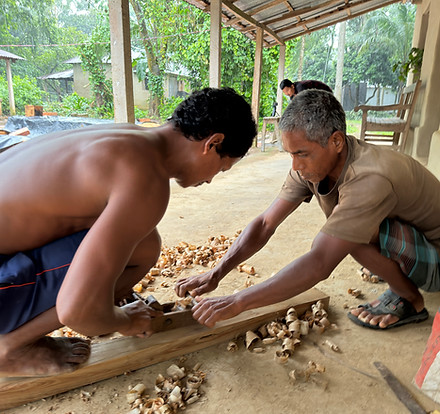
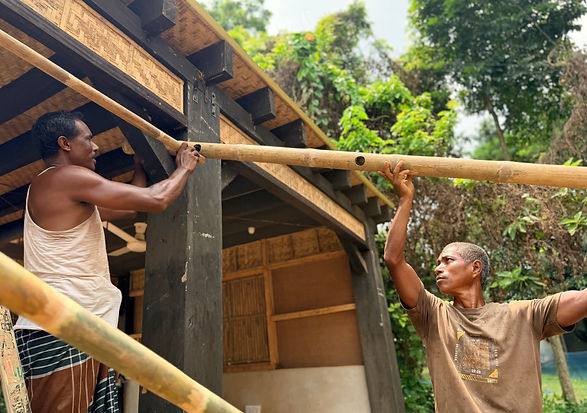
We started restoring traditional Garo mud houses, an outdoor kitchen and dining area, and the highly important firepit. We also knew a visitor’s admiration wouldn't compensate for a poor night’s sleep. People needed comfort if they were going to come, stay and return. We created two guest rooms for four people, with comfortable beds, spacious private bathrooms and hot water. We made outdoor seating areas and a bamboo Garo house where guests could listen to the birds and watch the sunset.
The scale was deliberate. Four visitors can get to know the people hosting them. They can spend time with Didi as she cooks, visit Francila Nokrek at her loom, enjoy the traditional dances of Prakriti and her friends, and, with Sagar’s help, follow a conversation whenever needed. A question can lead somewhere unexpected without a group needing to move on.
Guests can cycle through the fields, walk through the village, read, eat well and rest. There is no obligation to turn every hour into a lesson.
Yet the opportunity to learn is everywhere, provided we are willing to recognise our hosts as people with knowledge and authority of their own.
Cooking, weaving, guiding and storytelling are skilled work. Paying for that work gives a visit a practical value beyond appreciation. It can create reasons to use and pass on knowledge, while the people who hold it decide what they wish to share.

There are of course limits. A guesthouse cannot resolve insecure land, repair an education system or guarantee that a language will endure. Four visitors cannot carry those responsibilities.
They can, however, stop being strangers to the people affected. Especially when those visitors work in institutions whose decisions, priorities and accounts of Bangladesh carry influence.
I want the internationals in Dhaka to feel challenged by this invitation.
We should feel uncomfortable if we can speak at length about community engagement but have never sat down with the Indigenous people living within reach of us. We should question why another weekend at the club feels straightforward while accepting a village family’s welcome feels like an expedition.
The Garo are making an effort to bridge that distance. They have prepared rooms, organised meals, made time to guide visitors and offered to share parts of their lives. They are doing the work of receiving us.
We ought to make the effort to arrive.
Bangladesh includes the city where we work and the refugee camps that rightly command international attention. It also includes places that rarely enter our conversations, inhabited by people whose names we have never learned.
A weekend in Nalikhali will not make anyone an expert. It may do something more useful at the beginning: make you realise how much you have yet to ask.
Come for the fresh air, the food, the bicycle rides or the chance to sleep somewhere quieter. Sit with your hosts. Learn their names. Let them show you what they consider worth knowing. Bring that encounter back into your conversations in Dhaka.
Prakriti did not begin by asking me for anything. She made something she knew how to make, looked up to see whether I was watching, and placed it in my hands.
The distance between us began to close when I moved my chair.
See you in Nalikhali at: The Garo Experience: www.ethnomad.com/garoexperience


Night falls over the Garo homestead in Nalikhali, with the kitchen lit beyond the courtyard fire pit and guest rooms to the right (left). In the kitchen, Bizoli and Prakriti prepare breakfast for visitors (centre). A restored double room opens beneath a woven bamboo ceiling, with a mosquito net over the bed and a private bathroom beyond (right). The houses have been adapted to welcome guests while remaining part of a working family home.

Conservation Ethnography places people, culture, and lived knowledge at the heart of environmental protection. It asks who speaks for land, whose knowledge shapes policy, and how conservation can work with, not against, communities. At a time of climate crisis and displacement, understanding culture is not optional. It is essential.